

The single most important number in AI right now has nothing to do with benchmarks, parameters, revenue, or compute. That number is 99.
According to a Data for Progress survey from February, voters who rarely or never use AI view the technology unfavorably by a 42-point margin. Voters who use it at least once a day? Favorable by 57 points.
A 99-point swing.
We all know it’s not just one poll. Navigator Research and Pew both found the same pattern: the groups who view AI most favorably are the groups who use it most. The Stanford HAI 2026 AI Index, released Monday, found a 50-point gap between AI experts and the general public on AI’s impact on jobs.
This isn’t new ground for readers of this newsletter. As I wrote earlier this year, the conventional response from the AI industry has been to treat this as an education problem. If people just understood the technology better, they’d come around. More blog posts. More explainer videos.
But the data doesn’t say people need to understand AI better. It’s telling us they need to touch it. They need to use it for something that matters to them, not in the abstract, but In their actual lives. And right now, the industry is failing spectacularly at making that happen for the vast majority of Americans.
The original corporate experience lab
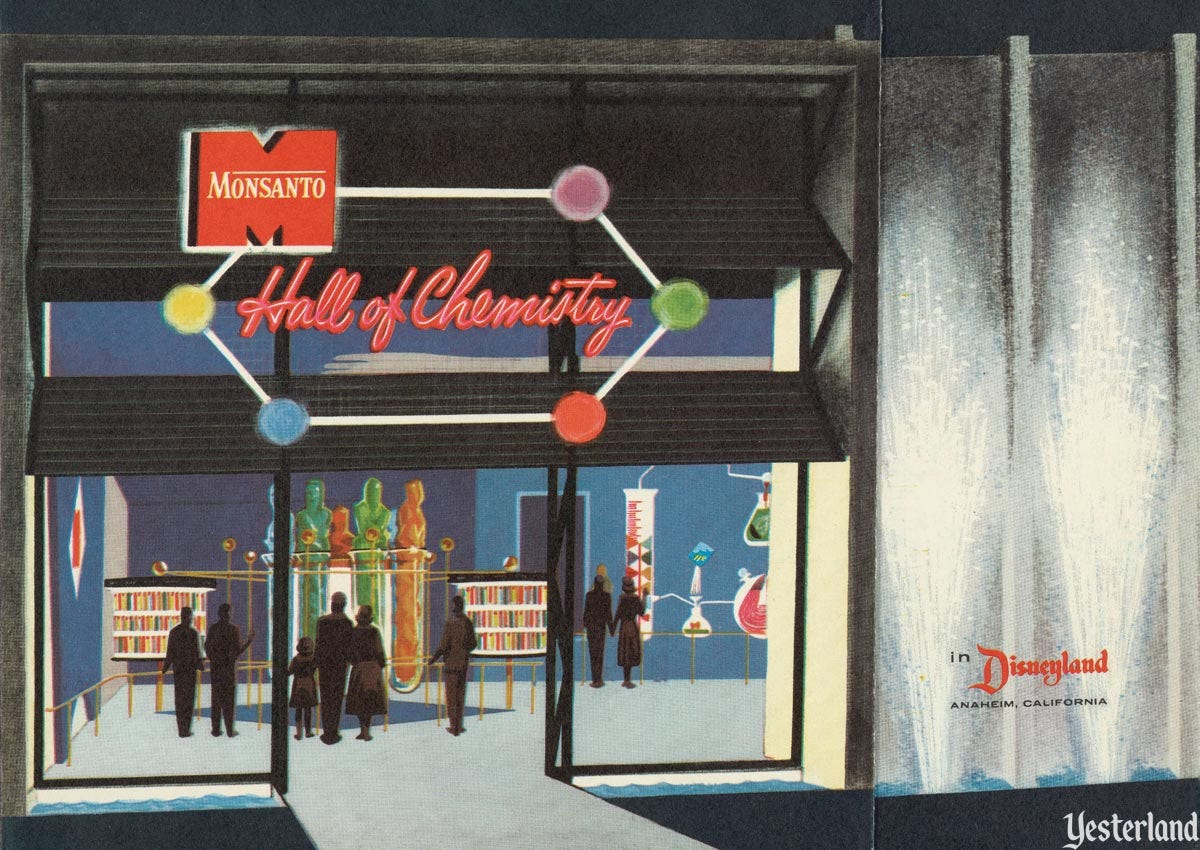
When Disneyland opened on July 17, 1955, Tomorrowland was, by Walt Disney’s own admission, a bit of a mess.1 It was the last land to be finished, budget cuts had gutted the original plans, and what remained was, basically, a corporate showcase. Monsanto sponsored the Hall of Chemistry. Kaiser Aluminum had the Hall of Aluminum Fame. Richfield Oil backed Autopia. TWA put its name on Rocket to the Moon. American Motors sponsored Circarama Theater. There was even a Bathroom of Tomorrow that was basically a giant ad for Crane Plumbing.
But despite how overtly branded it all was, people went and experienced it. They drove on Disney’s model of a limited-access freeway at Autopia 11 months before Eisenhower signed the Federal-Aid Highway Act. They walked through Monsanto’s House of the Future and saw microwave ovens most Americans wouldn’t own for another two decades, wall-mounted televisions, and picture phones. They stood inside Circarama, an 11-camera 360-degree theater that was effectively a VR room 60 years before consumer VR. They took a simulated trip to the moon 14 years before Apollo 11.
And then Walt did it again. For the 1964 New York World’s Fair, he partnered with Ford, General Electric, Pepsi-Cola, and the state of Illinois to create four major attractions. GE funded the Carousel of Progress, a rotating theater showing how electricity had transformed American domestic life through the decades.2 Ford commissioned the Magic Skyway.
The exhibits were so popular that they boosted their sponsors’ sales, and all four eventually migrated to Disney parks. The fair itself drew 51 million visitors across its two seasons, roughly the same attendance Disneyland did in its first decade.
The app is not enough
This wasn’t quite advertising, and it wasn’t quite education. It was experience design at a scale that changed how millions of people felt about the future. And it worked because Disney understood something that the AI industry hasn’t yet figured out: you don’t convince people the future is good by telling them. You let them live in it for twenty minutes.
For the past two decades of our internet-dominated public lives, the answer has been: here’s an app, go figure it out. 56% of Americans already use AI tools, according to Brookings, and for the ones who’ve made the leap using these tools to write, plan, or debug, it actually is transformative. The polling proves it.
But pulling your phone out of your pocket is not an interruptive experience. It requires you to have already decided AI is worth your time, already overcome the cultural headwinds, and figured out a specific use case on your own. That’s asking a lot of people who, by a 23-point margin, think the risks of AI outweigh the benefits.
Google’s Super Bowl ad this year was the closest anyone has come to getting this right. A mom and her kid, anxious about moving, using Gemini to visualize what the empty rooms would look like with their stuff in them. Pulling color palettes from family photos. No parameters. No mention of the model. The ad barely said the word “Gemini.” It was entirely about a job to be done, to steal the Clayton Christensen framework, that has nothing to do with AI and everything to do with making a scary life transition feel manageable.
But an ad is still an ad. Sixty seconds of watching someone else use AI is not the same as using it yourself.
What Tomorrowland would look like today
If I were at OpenAI, Anthropic, or Google, I’d be obsessing over this question: how do you create physical, experiential encounters with AI that meet people where they already are?
Not “come to our AI experience center.” Not a tech demo at TED. Something closer to what Disney and his corporate partners did: experiences about something people already care about, that involve AI without being about AI.
Go looking for a real, physical AI encounter in the United States today — a place where a non-user can walk in and touch the technology — and you find Refik Anadol’s Unsupervised at MoMA, which drew enormous crowds for five months in 2022 and 2023, and a long-teased spin-off called Dataland in Los Angeles that still hasn’t opened. That’s art, not product. The closest thing on the product side is Meta AI running on Ray-Ban Meta glasses through LensCrafters. Frontier labs have no sustained physical consumer presence at all. They’ve outsourced civilian first-touch to hardware retailers they don’t control and one Refik Anadol.
Imagine a Home Depot aisle where you point at the part under your sink and get a three-step repair plan with the exact SKUs on this store’s shelves. A grocery store that proposes three dinners using what’s in your pantry plus two items on sale this week. A high school counselor’s office where the AI reads a transcript and produces a realistic reach-match-safety college list in the same meeting the family is already having. The common thread: the person is physically where the job happens, the AI does something that depends on the environment, and a trusted local intermediary stands between the user and the model.
Walt didn’t build Tomorrowland alone. He went to Monsanto, TWA, Kaiser Aluminum, and said: we’re going to build a place where people can experience the future, and you’re going to sponsor it. Those companies got that Disney could deliver an audience at a scale no corporate showroom ever could.
The AI companies have something Disney never did: an experience they can put in everyone’s hand, no animatronic house required. Put someone in front of a screen, tell them to point at their living room, and watch their face when the AI redesigns it in real time. What’s missing isn’t the raw material. It’s the intentional experience design that takes AI out of the phone and into someone’s life at a moment they didn’t expect.
The testing grounds still exist. U.S. public libraries log more than a billion in-person visits a year across 17,000 branches. The Smithsonian draws well over 15 million visitors a year across 21 museums—all free. State fairs move millions. Expo 2025 Osaka drew 29 million last year, the closest thing the modern world has to the 1964 New York World’s Fair, and no frontier AI lab showed up. None of these venues are being used seriously by the companies building the most important technology of the decade.
The precedent that matters most is the one staring the industry in the face. Starting in 1997, the Gates Foundation put internet-connected PCs in more than 11,000 American libraries, which is how a very large number of Americans first touched the web.3
OpenAI has ChatGPT Edu. Anthropic has Claude for Education. Google has Google for Education. These are basically licensing programs. They are useful. They are not encounters.
Every AI company is spending untold sums on content marketing, developer relations, and ads. That works for the audience that already gets it. For the other 74% of Americans who don’t, information isn’t the bottleneck. Experience is.
No amount of content marketing will close a 99-point opinion gap. That gap closes one person at a time, the moment they use AI for something that actually matters to them and think: Oh, I get it.
Astute Person Familiar readers will recognize this is the second reference to Tomorrowland in the last three months. I think a lot about how Disney told stories, because in many ways it’s how America itself tells stories now.
They were also doing a little PR cleanup from a price-fixing scandal.
Along with ubiquitous AOL CDs in the mail.
Great piece, Jim. You put a lot of things that have been rattling around in my thoughts into a coherent vision. Thanks for writing.