

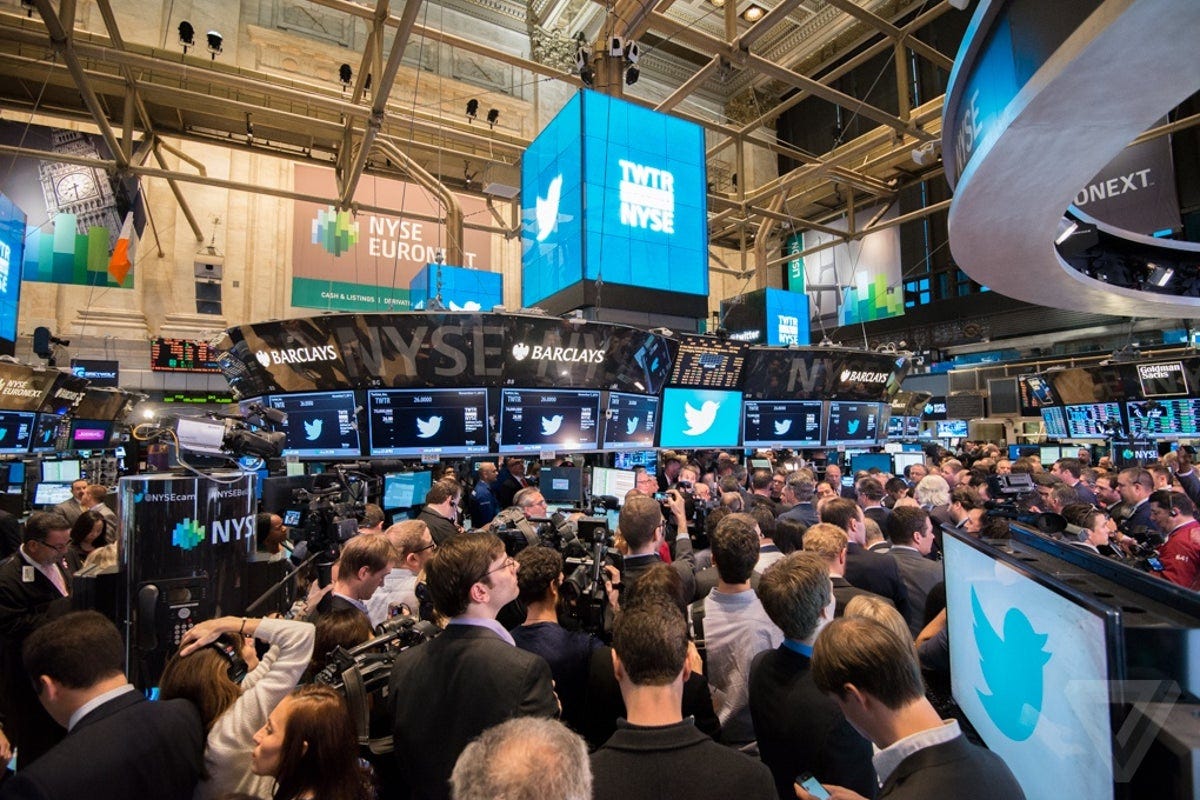
Anthropic is set to price its IPO on Wednesday and start trading Thursday. Most of the worry this week will be about whether the deal holds up amid the Nvidia of it all.
Fair enough. The worst thing that can happen to a company going public is a poorly received IPO. Facebook’s 2012 listing is the canonical one in tech: a botched listing day with the stock in the hole for fourteen months before it closed back above its $38 IPO price.1
But the second-worst thing that can happen is a wildly well-received IPO. Being wildly well received means you did your job and told a good story. The trouble is everything that follows. I learned that firsthand when we took Twitter public in 2013.
We priced at $26 and opened at $45.10. We thought the stock was fairly priced at the IPO, and that was a more than respectable pop.
Then it started climbing toward $74, $75 a share, and that was a fairly nervous time. As cool as it is to watch your company’s stock skyrocket, it raises the stakes considerably. You now have to not only perform to expectations but overperform them. The scorecard changes on you, without any new information.
In prep for our first earnings call, we all knew in that room the company was not worth that. But there was nothing we could do about it. You can’t control the market or the stock price. You can control your results, but you only get four opportunities a year to disclose them.
By the new year we were bracing for impact. Walking around the office felt like the moment in a disaster movie when the protagonist knows about the bomb, looks around a crowded room, and thinks, none of these people know what’s coming. People were riding so high. You could almost telepathically tell who was counting up their net worth off the current share price.
On February 5, 2014, we reported our first quarter as a public company. Revenue had more than doubled from a year earlier, to $242.7 million, and the next day the stock closed down 24%. Revenue was never our problem. Slowing user growth was: still up, mind you, just not as fast as the Street wanted.
Twitter wasn’t a fluke
“But Jim,” you say, “Twitter was a clown car” (or “goat rodeo” as Kara Swisher so loved to call us). So I went back and pulled data on every US tech IPO since 2011 that closed at double its IPO price or better before its first earnings report, 68 in all.2 The majority of their first reports looked more like ours than the opposite.
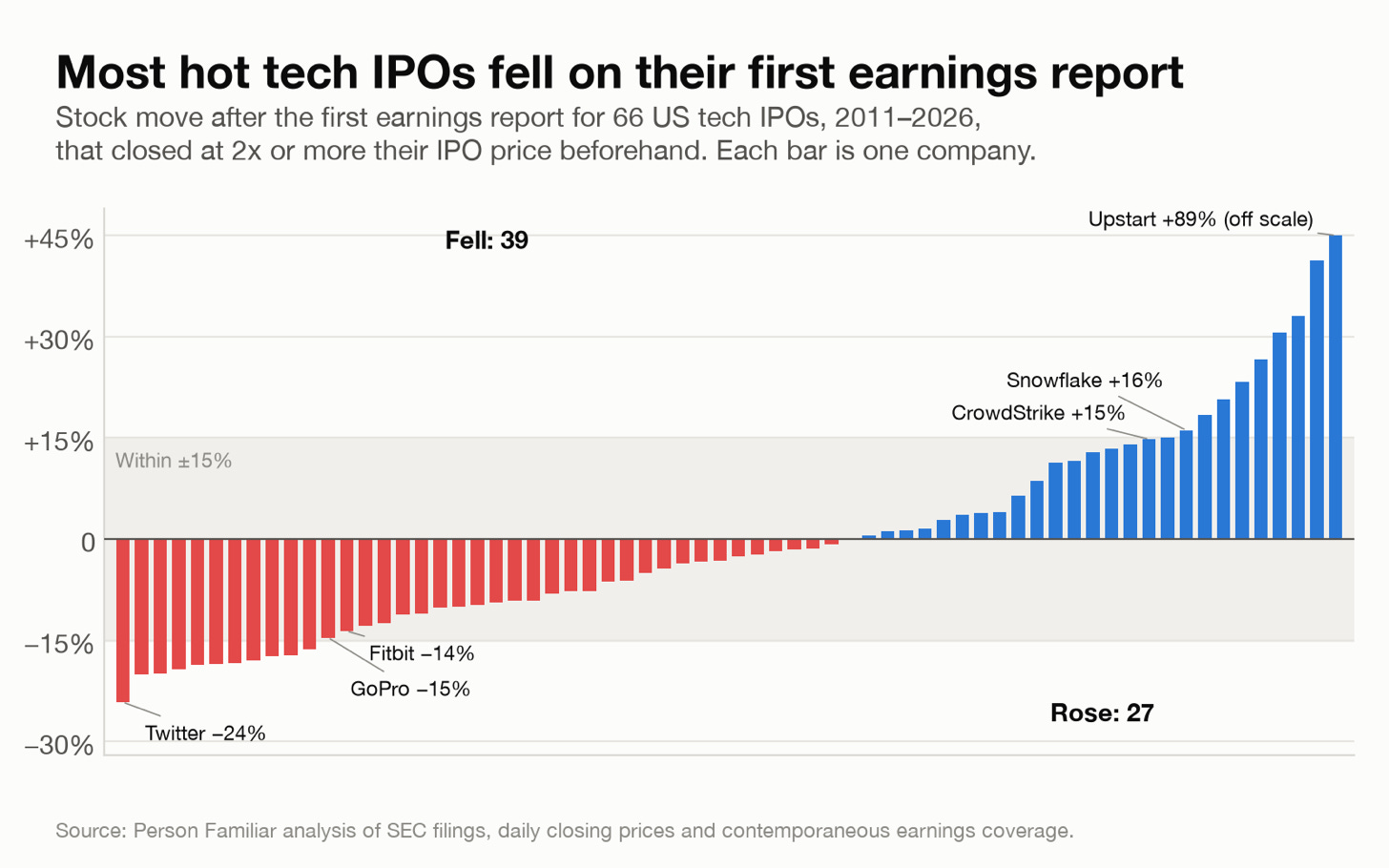
Most of them fell, and fell big. Fewer than half stayed within 10% in either direction. And it wasn’t for lack of beating the numbers: of the 46 that topped analysts’ revenue estimates, 26 fell anyway, and so did 11 of the 18 that beat on revenue and guided above consensus.
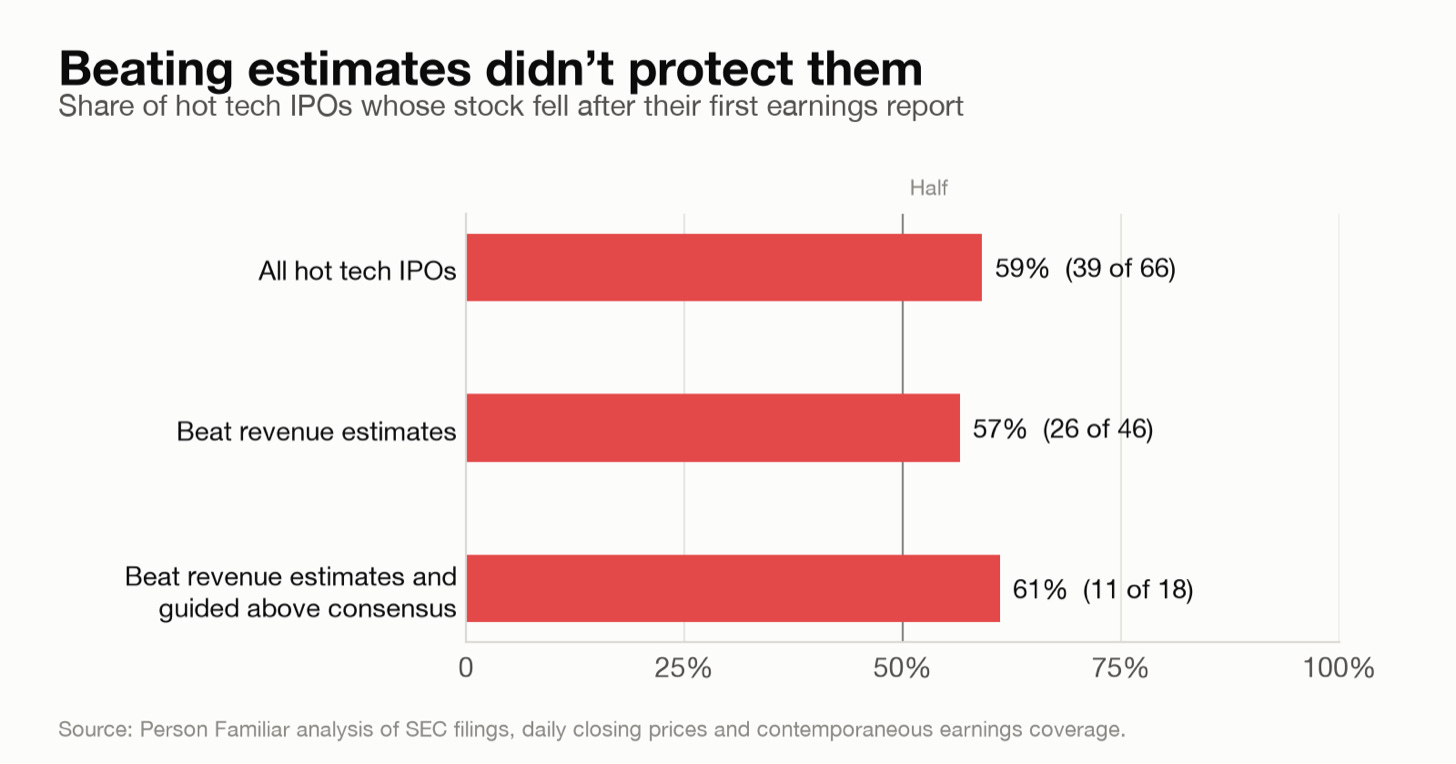
Often the market had found a different number to grade them on, the way it decided on users for us. Fitbit’s revenue came in $80 million ahead of estimates in 2015, and the stock fell about 14% because its gross margin narrowed. In about half of the cases where a company beat and still fell, though, the coverage couldn’t point to anything but the price.
The companies that came through it well had the fantastic earnings the price was asking for. CrowdStrike jumped after its first report in 2019. When the scorecard changes and you still manage to meet it, life is great.3
The peak doesn’t come back
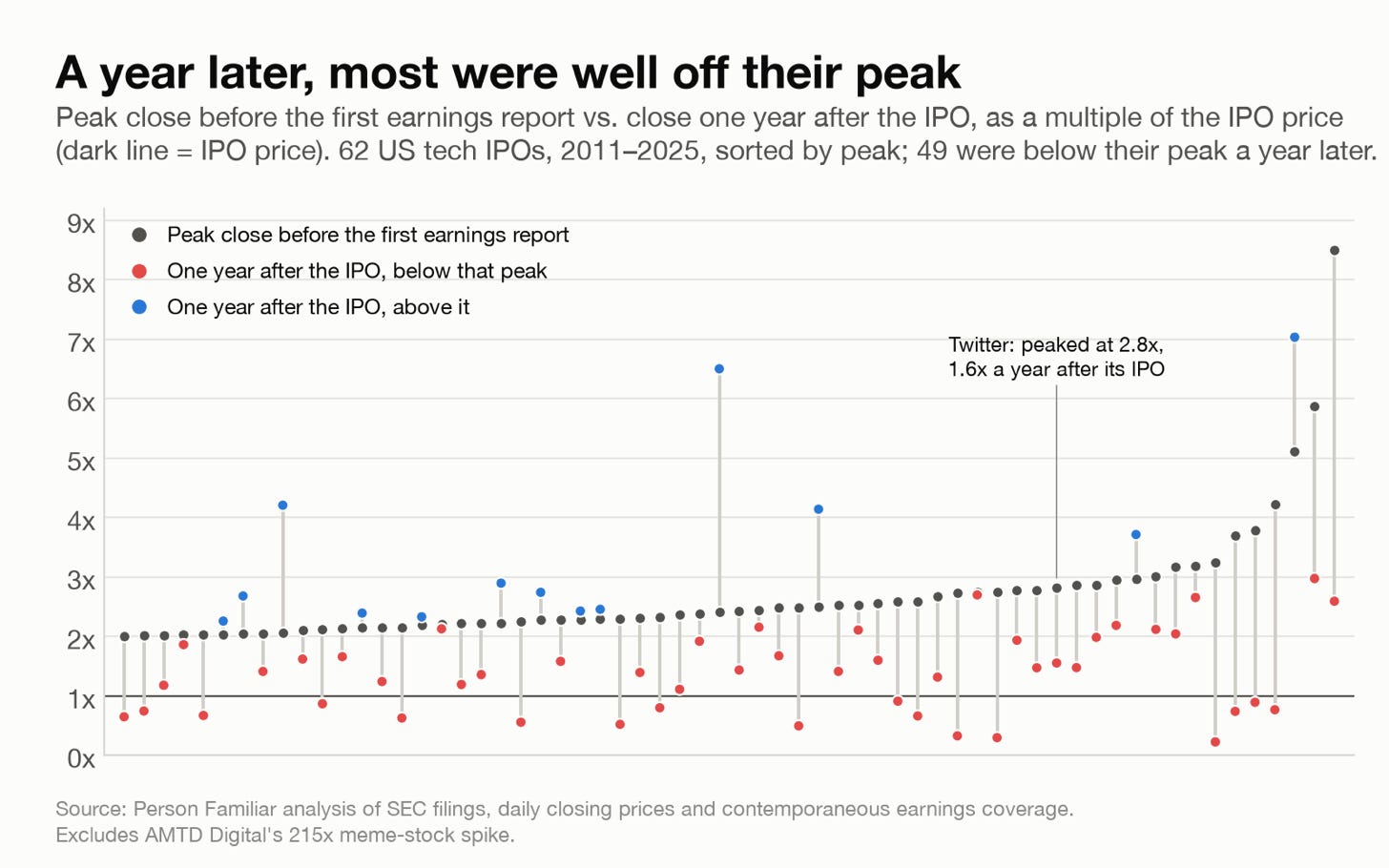
A year after the IPO, 49 of the 62 companies were below their pre-earnings peak. The typical one had given back about 40% of its peak value, and 18 were below their IPO price. If you were an employee counting up your net worth off that peak, at most of these companies you didn’t see that number again within the year.
At Twitter, our February drop was just as agonizing for our employees as the ecstasy of nearly $75 a share had been. Then the lockup expired on May 6, and the stock hit new lows that day. There was a palpable frustration that investors had been able to sell before employees had. We’d worked out a carve-out that let employees sell some shares ahead of the lockup, but only enough to cover taxes.
So I don’t buy the argument that a pop is good for employees. You have to be a seller to take advantage of a pop, and most employees are still holding.4
If you’re running comms or IR for the next hot IPO
We’ll have to grade “wildly well received” on a curve right now. The last few weeks, particularly with Nvidia, have cast a cloud over AI stocks, so call it rough justice, but I’d say anything from up 50% to up 100% would be considered wildly well received for Anthropic. Whatever happens on Thursday, here’s what I’d want in place at the next one.
Plan for the whole range of outcomes. You can beat and still fall, so if I could pick one thing for you to do, it would be to have very honest conversations with your CEO, CFO, and IR team about all the ranges of possibilities and what you’ll do in each. My rough rule is that a move of less than 10% to 15% in either direction on the first earnings call is where you want to be. Anything more than 15% is a break-glass moment for your employees and your public shareholders.
Have two quarters in the bag before you go out. By “in the bag” I mean line of sight to predictable growth in all of your key metrics, and knowing what your levers for growth are and how to use them. Guiding low enough to beat is a different thing, and a risky one. A newly public CFO is demonstrating to the Street why they’re credible, so sandbagging is a great way to convince the Street that you’re not. Twitter had line of sight into revenue. We did not have line of sight into users, and users became the thing investors and analysts focused on most.
Educate employees about public company life, not just the IPO. If you’re trying to teach them about markets and equity after the stock has run, you’ve waited too long. At Twitter we tried to bring people along as much as we could, within the legal lines of not giving financial advice: how markets work, how IPOs work, what the trading windows will be and why. No surprises is the thing.
Keep hammering one line. At our Friday all-hands, our CEO Dick Costolo and CFO Mike Gupta kept reminding people that we’re never as brilliant as our stock price says, and we’re never as dumb as our stock price says. I’d keep hammering that line every time the stock has a big run-up or a big drop.
Think past the first call. It’s really about the first two calls, and if you want to be more expansive, your first year and a story that adds up over time. Four calls with four different stories gets you into a dangerous place, where it always feels like you’re telling a story instead of telling a strategy.
I’ve been throwing around words like “worst,” and that sounds like a permanent judgment, but it’s a temporary state. Facebook was in a hole for more than a year, worked its way out, and is one of the most valuable companies in the world today.
To my friends and readers at Anthropic, have fun this week and enjoy the moment. And buckle up.
I guess you could say things have worked out okay since then.
Traditional US-listed tech IPOs from January 2011 through September 2026 that raised at least $100 million and closed at twice the IPO price or better at least once before the first earnings release. Two of the 68 lack a reliable first-report move, so the first two charts show 66, and the one-year chart covers the 62 old enough to measure (it leaves out AMTD Digital’s 215x meme-stock spike).
Former Google CEO Eric Schmidt was fond of telling us at post-earnings TGIF all-hands meetings “Revenue solves all known problems.” That probably deserves more than a few caveats.
Anthropic deserves some real credit here, though. Under its latest S-1 amendment, non-founder employees can sell 10% of their locked-up shares on the first trading day and another 35% two trading days after the company’s first full-year results. That’s a meaningful amount of liquidity early on, which most employees at newly public companies don’t get.