

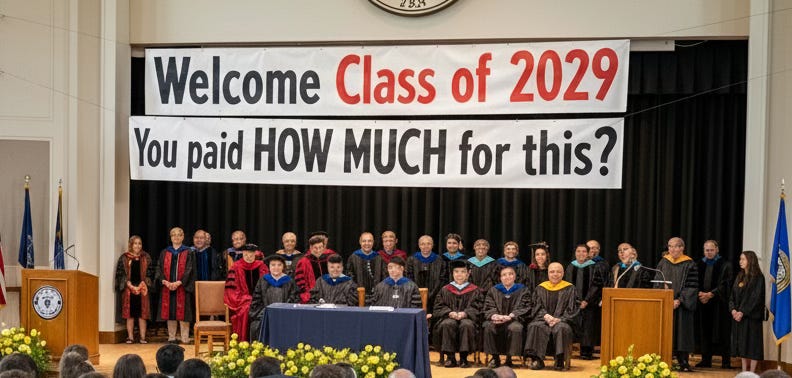
It's estimated about 20 million Americans started or will be starting undergraduate studies this fall. If past trends hold up, about half a million of those students will want to go into communications and public relations after getting their degree.
Sorry to say, but most are about to spend four years learning skills that will be obsolete by graduation. If you're taking traditional PR courses right now—media relations, press release writing, crisis communications—you're studying the professional equivalent of Latin. Foundational? Sure. Hireable in 2028? Dubious.
So what should you do if you're one of these half-million young adults set to emerge into this shifting land mass? I have a few thoughts, but I also asked a bunch of other friends who are smart about comms and the future and who live on the cutting edge of today's movements in tech and comms.
Video, Video, Video
Here's a generational tell: When something interesting happens, millennials take a photo. Gen Z takes a video. That instinct represents everything about where communications is headed. Yet walk into any classroom and you'll find students learning to write press releases like it's 2005.
Good writing still matters, but the delivery channels are shifting unmistakably. Every consumption metric points the same direction: video is eating everything. But PR remains a profession built on the written word, desperately clinging to press releases and pitch emails while the world has moved on to TikTok and YouTube.
If you want to stand out from those other 499,999 students, get extraordinarily good at making video content. Not "I can shoot something on my phone" good. I mean understanding composition, editing, pacing. Know why some videos get shared and others die in obscurity. Learn Premiere or Final Cut. Understand color grading. Record clean audio. These are becoming table stakes for communicating in a world where everyone expects information in 30-second visual bursts.
AI: Be a Builder, Not a User
You're entering college at the exact moment a new technological paradigm is being born. The last time this happened was 1994 with the commercial internet. Those students who recognized the moment? They ended up running the digital world.
Every career advisor and media pundit is telling you to "learn AI." What they're usually holding in their mind is: write better ChatGPT prompts. But that's user-level thinking. It's the equivalent of telling 1994 students to get really good at Yahoo searches. The real opportunity isn't in becoming a power user of AI tools. It's in becoming a builder with them.
Let’s say you’re at a future summer internship with an agency. Can't get reporters to respond to pitches? Build a tool that analyzes their recent coverage and suggests personalized angles. Notice your internship involves hours of routine tasks? Automate them. See a communication problem nobody's solving? Solve it.
You don't need to become a software engineer. But you do need to understand these systems well enough to direct them toward solving real problems. While senior professionals are struggling to understand what an LLM is, you can be building the tools that will define how PR works for the next decade. That makes you immediately hireable and will distinguish you in the pack.
The Reality Check
The PR industry loves to talk about "digital transformation" and other euphemisms for "we have no idea what we're doing." But your generation doesn't need euphemisms. You're already living in the transformed world. Your instincts toward video, toward AI, toward building rather than consuming—these aren't generational quirks. They're professional superpowers.
Don't wait for permission. Don't wait for the curriculum to catch up. And definitely don't wait for someone else to figure it out first.
And Now, Some Wisdom from Friends Smarter Than Me
"AI is a human scaling technology—like the wheel, electricity, the combustion engine, the transistor—it will scale the ability of humans to think, learn, build and produce. As such, people with a passion for a subject—be it engineering, art, literature or history—will be the ones best positioned to benefit from this technology because their very passion will fuel the creativity that the technology will scale. Pursue what you love, not what you think will be the job that will exist in the future — and in so doing you will best set yourself up for living the good life in the Intelligence Age."
- Chris Lehane, Chief Global Affairs Officer @ OpenAI, former SVP of policy and communications @ Airbnb and Democratic campaign strategist
“Pay attention to relationships, storytelling and the evolution of influence. You'll find that the medium that is effective today may not be the same one tomorrow -- so have broad proficiency in as many as possible, but always be great at understanding what persuades, what resonates as a message, and then build from there.”
- Frank X. Shaw, Chief Communications Officer @ Microsoft
“Think about your late night doom-scrolling as study hall. Every swipe on social media is a masterclass in how people and brands connect, share, and react—powerful skills you can flip into owning your narrative and creating direct relationships with your audience. Also, gen AI will put you out of a job so instead learn how it will make you exceptional at your job.”
- Brandee Barker, VP of Communications @ GM, Facebook’s first global head of communications
"Pay attention to the world. Exceptional communications is about understanding the nature of societies and what moves people. The whole world is being reconfigured by a vortex of forces, from the technological to the geopolitical. If you fail to pay attention to the entire complex mosaic of 21st century life, you'll be as irrelevant as most communications strategies are to convincing people. If I was giving another piece of advice, it's to be the best. There's no prize for second place in the age of AI, and we're starting to see the intensification of competition for jobs, as companies themselves feel the heat against hungrier, more dynamic players. Average graduates will find it harder and harder to beat above average AI."
- Dex Hunter-Torricke, former head of comms @ SpaceX, former exec comms lead @ Facebook/Meta, speechwriter for Google CEO Eric Schmidt and UN Secretary-General Bam Ki-moon
"Think of where you've had an interaction with a professional where you've appreciated that human moment. Maybe it was the mechanic who repaired your car. Or thetherapist who made you feel seen. Or the ceramicist whose pottery spoke to a deep part of you. I think many of those interactions will be durable and are indicative of jobs that will remain valuable going forward. Some won't, but many will continue."
- Gabriel Stricker, Chief Communications and Marketing Officer @ Cancer Research Institute, former head of comms @ Color, Emerson Collective, and Twitter
"Read books. Real books. As many as you can. Maybe publishers can put a “written by a human” little gold seal on the cover, so we know we’re consuming original thoughts? Don’t use AI as a writing crutch. Take the time to search the back of your mind for just that right word or phrase. It’s like when we all started Googling the names of movies and songs that we couldn’t recall on the spot. And now we can’t remember anything. Collect words. Maybe this is corny, but I have both a handwritten and Notes app list of words and phrases that I overhear and want to use. Nurture relationships. Real, human relationships. Learn to read body language, sense subtle changes in atmospherics, and practice conflict and repair. I cannot overstate how critical this skill has been in my career."
- Niki Christoff, founder @ Christoff & Co., former senior public policy executive @ Salesforce, Uber, and Google
"Should: Be consumers and creators of content. Businesses want expertise so if you want to work in a certain sector like AI or finance or politics know the influencers that matter and be proactive about creating a blog, videos, or podcast so employers see you as a day one contributor to a company or agency. Shouldn’t: Pursue a Master’s degree over real world experience, get going early."
- John O'Brien, founder at @ SBS Comms
"Apply for internships, seek out mentors, and stay in touch with them after you return to school. Focus on building a strong portfolio starting now. Collect writing samples, social posts, campaigns, or multimedia projects throughout college so by graduation you can show employers your skills."
- Nu Wexler, founder @ Four Corners Public Affairs, former policy comms leader @ Google, Meta, and Twitter
"Start writing and creating asap — Substack, TikTok, etc - the future belongs to those who demonstrate they know how to build audiences, clearly communicate, and get creative with format and mediums. You don’t have to be an influencer but in the same way design and architecture students graduate with a portfolio, so too should aspiring comms professionals."
- Rachael Horwitz, Chief Marketing Officer @ Haun Ventures, former VP of Communications @ Coinbase
“Relationships are everything! Your career will have many chapters, each serving a different purpose. One might be about learning a new domain or skill, another about working alongside influential leaders — sometimes both at once. Together, these experiences compound over time and the relationships you make and nurture will carry through each chapter.”
- Lindsay McCallum Rémy, product communications @ OpenAI, former head of product communications @ Twitter
"Find an emerging industry and seek out every resource you can to learn about it. For me it was crypto, starting as a reporter before going to both agency and in-house communications and media relations work. Today, chips, quantum, AI, and machine learning, are all new emerging areas where strong technical understanding coupled with strong media instincts can make you extremely valuable in the job market."
- Leslie Ankney, head of communications @ Sui Foundation, former head of comms @ Anchorage Digital
What a fabulous, thoughtful insights-rich piece. I particularly like your comment about moving beyond being a user and becoming a builder.
One of the most exciting parts of the AI class I teach is when we begin an exercise where we look at agents, where rather than thinking about how we can use AI to do the same things faster, more efficiently etc., but to think of what your dream solution would be to an issue (your pitch insights tool is a great example) and work back to see what systems need to connect to make things work.
It generates the most user-centric, actual problem-solving solutions - where the tools to build are at our fingertips.