

Almost everything written about AI and communications centers around productivity. How to crank out press releases faster, automate briefing docs, that kind of stuff. And that’s all correct: there’s real value in getting the grunt work done so people can focus on the parts of comms that actually require human judgment, creativity, emotions, and relationships.
But what I’ve been thinking about is that these tools don’t just help you write faster or generate media. They let you build things. This isn’t a grand revelation: vibe coding is a broadly understood thing. But I’m not sure the comms world has fully absorbed its significance and meaning or what’s now possible in the same way other disciplines have.
When I came to Google in 2010, the way the comms team assembled daily press coverage was, I kid you not, a rotating cast of the most junior people on the team would grind through manual Google News searches. We were at Google, for Pete’s sake, the Mecca for innovative software answers to information organization. It was absurd.
I made it my own little 20% time1 mission to try to find engineers who’d spare some resources to build us something better. There were some fits and starts, but it never happened in my tenure.
Flash forward to my time at Twitter. We’d have creative ideas for things we wanted to make—interactive experiences, stuff that could capture a cultural moment in ways that just lists of Tweets and press blasts couldn’t. The product and engineering teams were always sympathetic, but they’d come back and say they were slammed building whatever new thing leadership was prioritizing that quarter.
The ideas and spirit were always there. We just never had the resources or technical know-how ourselves to actually execute.
What’s different now is that comms people have the capabilities at their fingertips to do the execution themselves.
This past weekend, on a lark, I built this thing called Workplace Buzzword Slots. It’s a slot machine that generates ridiculous workplace thought leadership slop in the style of those post-Davos trend reports that flood LinkedIn every January. You know the ones I mean: about how we’re all entering our “authentic leadership era” or whatever.
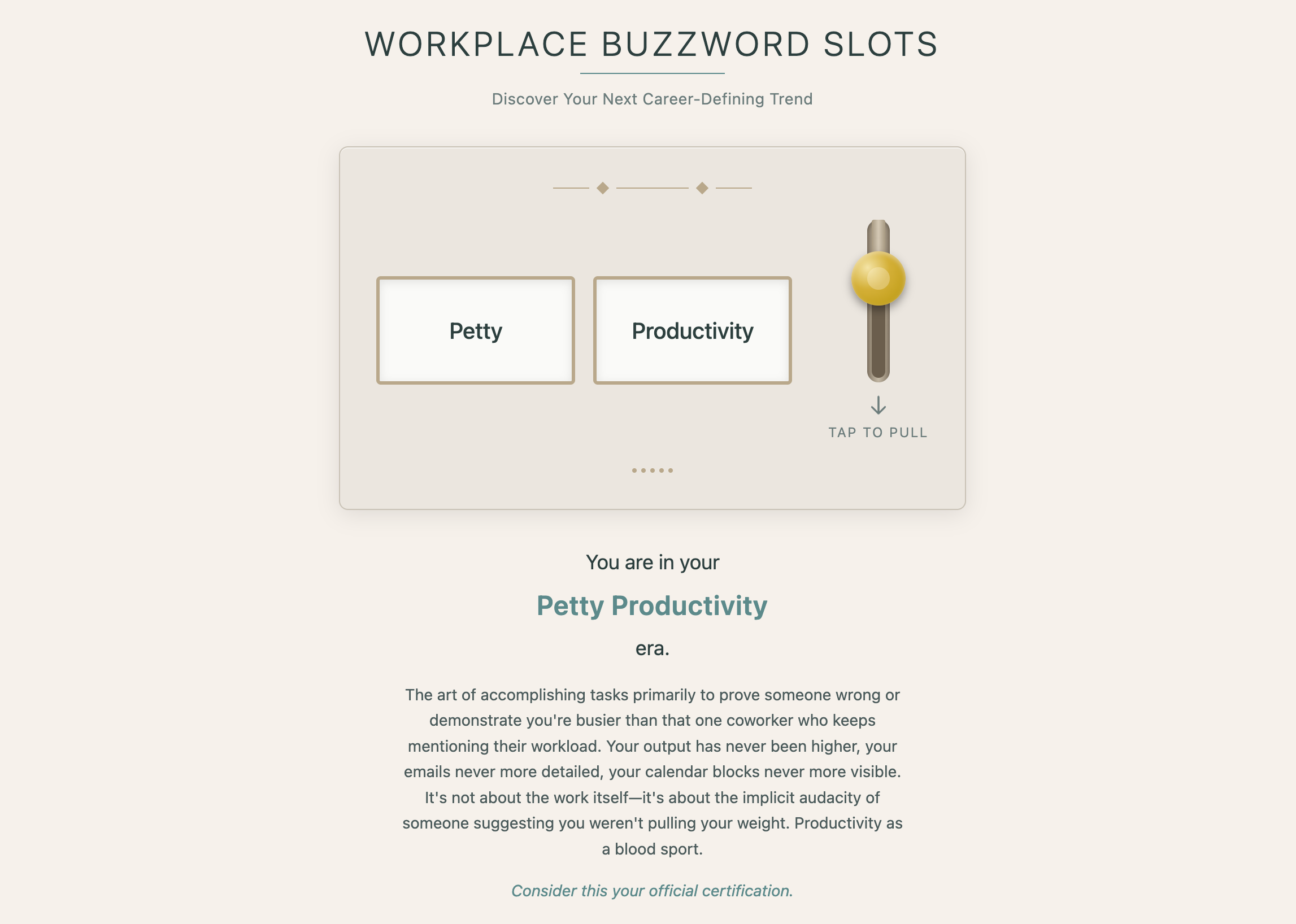
It took me a couple hours. I had the concept, the tone, and core mechanics, iterated on the design and features with Claude Code, pushed it to GitHub, deployed it through Vercel for free, spent twelve bucks on a domain, plugged in my Claude API key, and it was live. I’m not saying it’s going to win any engineering awards or a Cannes Lion. But I shipped it. And shipping matters.
The constraint for comms people building things is no longer getting engineering help. The greatest constraint is, quite honestly, that the profession’s use of AI is an inch deep and a mile wide. We’re not thinking about AI as a tool for creating things—interactive experiences, internal tools, games, prototypes—that are themselves a form of communication, the ultimate way of showing rather than telling.2
This is a new surface. And I mean that in the same way you’d talk about media relations or executive comms as distinct surfaces, each with their own logic and possibilities. A press release describes something. A tool demonstrates it. Those are different things.
If you’re early in your career or want to work in comms: don’t just be a user of AI, be a builder with it. You don’t have to be prolific. You don’t have to publish anything! But if you’re not at least tinkering with this stuff, you’re going to get left behind. If you become the person in your organization who can take an idea from concept to shipped thing, you’re going to have a long career.
And if you’re in-house at a tech company, all this matters even more. Your executives and your technical colleagues are all playing around with this stuff on their nights and weekends. They’re building things, shipping side projects, developing intuitions about what’s possible. If you’re doing the same, you gain legitimacy at the table.
I don’t know exactly where this goes. But I know that the comms people who start treating “what can I build?” as a real question are going to end up somewhere interesting. The rest of us will be catching up.
The famous “20% time” facet of Google culture was always something of a myth and more accurately described as “120% time”, but the spirit of it was inspiring nonetheless. It’s all but dead now alongside other touchstones of that time and place, and with it a special part of the company.
For what it’s worth, this applies to internal communications too, not just external. What tools could you build that would make information flow better inside your organization? What could you prototype to sell an idea before you’ve even put together the deck?
That header image is so relatable as a comms person who literally tried to vibe code my own version of Asana last night in Claude