

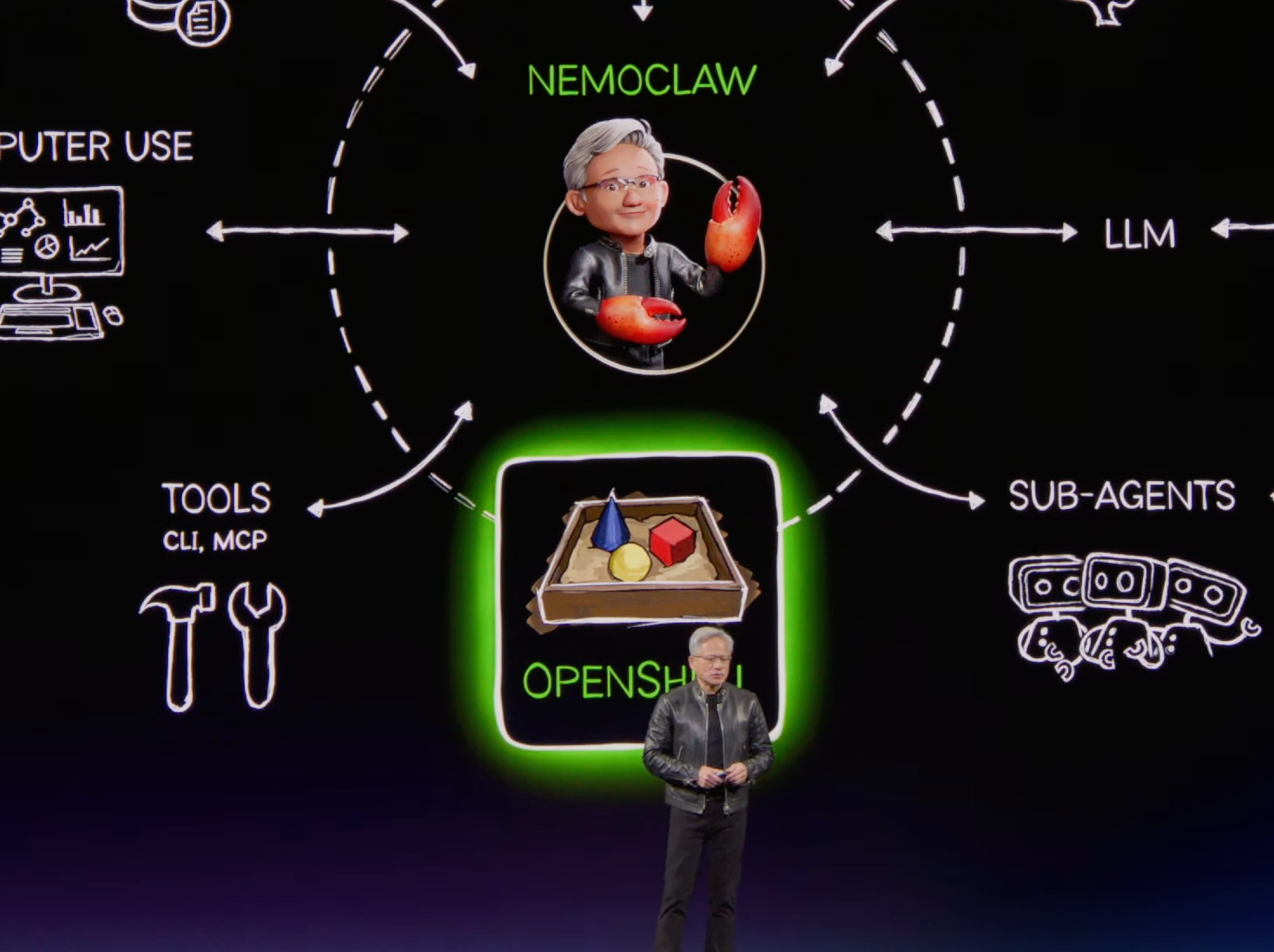
Jensen Huang walked onto the floor of San Jose’s SAP Center yesterday and held a capacity crowd’s attention for over two hours, no teleprompter, announcing $1 trillion in projected chip orders through 2027, a new rack architecture called Kyber, a prototype data center designed for space, and a live robotics demo starring Olaf from Frozen. He closed with singing robots and an animated lobster performing a campfire song.1
If you’re a communicator looking for actionable takeaways from all this, I can save you some time. Here’s one version of a playbook:
Be the CEO of the most important company in the world for the most important technology in the world right now.
Have cool jackets or some other signature piece of clothing.
Double your revenue estimates once or twice a year.
If you can be Jensen Huang and Nvidia, I highly recommend it. It seems to be going great and really fun.
But most of us and our executives can’t be Jensen and Nvidia, sadly. So if you’re studying yesterday’s GTC keynote looking for communications lessons (and you should be), what’s actually transferable? For me, it’s a specific technique he used that most companies could actually adapt, and that is quietly the most strategically savvy part of the entire two-hour performance.
To briefly head this off: yes, any time you talk about a live stage presentation by a tech exec, you’re implicitly judging it against Steve Jobs in the same way every rock band gets judged against The Beatles. Jobs understood the keynote as performance, not announcement, and so does Jensen. But Jobs sold clarity—the future simplified until you felt smart enough to buy it. Jensen sells complexity—the future rendered so technically dense that you need a guide through it, and he just spent two hours proving he’s the only person who sees the whole picture. Different trick.2
OK, moving on.
Category Coronation
Roughly two hours into the keynote, Jensen turned to OpenClaw, the open-source AI agent framework that’s taken the tech world by storm since January. Creator Peter Steinberger, who now works at OpenAI, was in the audience. Jensen called it “the most popular open source project in the history of humanity” and compared it to Linux, HTML, and Kubernetes, all foundational, era-defining protocols.
Then he said: “Every single company in the world today has to have an OpenClaw strategy.”
The CEO of a $4.5 trillion semiconductor company, at his own flagship event, used his stage to crown someone else’s project as the defining technology of a new era.3 He compared it to the technologies that built the entire fucking internet and said the entire enterprise world needs to reorganize around it.
That looks generous and visionary. It’s one of the most self-interested things he could do.
Every always-on autonomous agent is an inference call. Every inference call burns GPU cycles. Every CEO who walks out of that arena thinking “we need an always-on agent strategy” is a CEO who’s about to triple their inference compute budget. Jensen doesn’t care if you use OpenClaw or some other framework. He doesn’t care which models you run or whose API you call. He cares that you’re running persistent agents that consume compute 24/7 instead of intermittent prompt-response sessions.
“Every company needs an OpenClaw strategy” is Nvidia’s 2026 version of 1970s/1980s Microsoft’s mission of “a computer on every desk and in every home.”
This is a specific, nameable communications technique: category coronation as demand creation. You take something external (a technology, a movement, a shift in behavior) and you elevate it to the status of an inevitability. You don’t argue for your product. You argue for the world in which your product is essential. And once your audience accepts the paradigm shift, the downstream purchase becomes inevitable without ever needing to be argued for directly.
Jensen never said “buy more GPUs.” He just needed executives around the world to believe the age of autonomous agents had arrived. Gravity takes care of the rest.
Why Nobody Else Does This
The natural question is: if this works so well, why don’t more companies do it?
Partly it’s a confidence problem. Category coronation requires you to not talk about yourself for extended stretches, and most executives find that physically painful. Their boards want the product mentioned. Their sales teams want competitive comparisons. Their comms teams have been trained to measure success in share of voice and message pull-through. Spending five minutes of a keynote praising someone else’s open-source project that maybe about a couple million people worldwide have played with is, to put it mildly, not what the average VP of product marketing would recommend.
Partly it’s a structural problem. Most companies communicate in a sequence that feels logical but is actually backwards: product → features → market context. Here’s what we built. Here’s why it’s good. And then, if there’s time, a gesture at the broader shift that makes it relevant. Jensen inverts the entire thing: market context → paradigm shift → inevitability → (oh, and we happen to be the infrastructure underneath all of it). The product is never the subject of the sentence. The shift is the subject. The product is just... there. Quietly essential.
And partly it’s an earned-credibility problem. You could chalk this up to “well, Jensen can do this because he’s Jensen,” and that’s not entirely wrong. I’ve written before about attention strategies and whether you’ve earned the one you’re running. Jensen can pull off the Greatest Showman routine—the arena, the two-hour runtime, the Olaf cameo and the space data center teases—because the showmanship is built on delivered roadmaps and quarterly beats-and-raises.4 Strip away the leather jacket and the singing robots, and there’s still a $1 trillion order book. If Nvidia were missing shipments or Vera Rubin were vaporware, the keynote would feel like what I’ve called elsewhere vibe writing. All hat and no cattle.
But if you have the products and you have the results, you don’t need the leather jacket. The technique works at any scale, and the mechanics are the same.
The Three Moves
Start with the shift, not the product. What if the first five minutes of your CEO’s next keynote, blog post, or podcast appearance weren’t about your company at all? What if they were about a change in the world that your audience is already feeling but hasn’t quite named? Jensen opened not with Nvidia’s revenue but with the thesis that the token is the fundamental unit of a new computing paradigm. By the time he got to specific products, the audience had already bought the frame.
Crown something external. This is the part that feels counterintuitive, and it’s the part that makes the whole thing work. Find the technology, the movement, the behavioral shift that your product plugs into—and elevate that, not yourself. Jensen crowning OpenClaw as the Linux of the agentic era is structurally the same move as a cybersecurity company declaring “the zero-trust paradigm is now inevitable” or a fintech company saying “embedded finance is the new default.” You’re not selling. You’re declaring. And the declaration creates the demand.
Let the audience connect the dots. This is the hard part, and it’s where most companies flinch. If you’ve done the first two moves right—established the shift, crowned the external force—your audience is already thinking “okay, so who benefits from this?” The answer is you. But the moment you say it out loud, you break the spell. You go from prophet to salesman. Jensen’s discipline in never saying “buy GPUs” is the reason the whole thing lands. Most executives can’t resist drawing the line in crayon. Resist.
You could argue that category coronation only works when you’re the dominant infrastructure provider in a generational technology shift, and yeah, it helps. But the underlying structure—argue for the world, not the product; elevate something bigger than yourself; trust the audience to connect the dots—is available to anyone with a genuine thesis about why things are changing and the substance to back it up.
Jensen gets to be the showman because the cattle are real. But the showmanship isn’t the lesson. The lesson is that he never once, in two-plus hours, argued for Nvidia’s products. He argued for the inevitability of a world that runs on them.
I realize this reads like I stroked out while writing. I assure you, all this happened.
You could chalk some of the simplicity/complexity difference up to the nature of selling consumer products versus enterprise infrastructure, and that’s fair. But it doesn’t explain why no other infrastructure CEO communicates this way. Satya demos products. Sundar demos products. Jensen argues for paradigm shifts and lets the product sale happen as a consequence as natural as gravity.
OpenClaw’s creator Peter Steinberger joined OpenAI in February, and Sam Altman has committed to keeping it open source through a foundation. So Jensen is praising a project that now lives inside one of Nvidia’s largest customers, a company that is also, quietly, exploring custom silicon that could reduce its dependence on Nvidia’s GPUs. Only in AI.
Life lesson here: when you’re beating and raising, it’s cute. When you’re missing and pulling guidance, it’s fatal eccentricity.
Aptly said, Jim. Love the Microsoft analogy, too, on how to create and own a category. The difference b/t the two companies is that Nvidia arguably makes and enables far superior products. And to your point, Jensen doesn’t haven’t to tell you that.
Well said Jim, as Kroc learned he was in the real estate business, Huang has adopted the inevitability corollary