

Roughly $1 trillion in software market capitalization has been wiped out since mid-January. Here’s the thing, though: the earnings are fine.
Jamin Ball at Altimeter, whose Clouded Judgement newsletter is the sharpest ongoing analysis of the SaaS landscape, pointed out that Q4 results have actually been solid. Companies are hitting their numbers. Some are beating them handily. This isn’t a business crisis, but the stocks are cratering anyway. So what is it?
It’s a narrative crisis. And almost every SaaS CEO in America is making it worse. Except one shining example.
The Flavors of Flailing
A few distinct CEO response patterns have emerged from the wreckage of Q4 earnings calls and public statements:
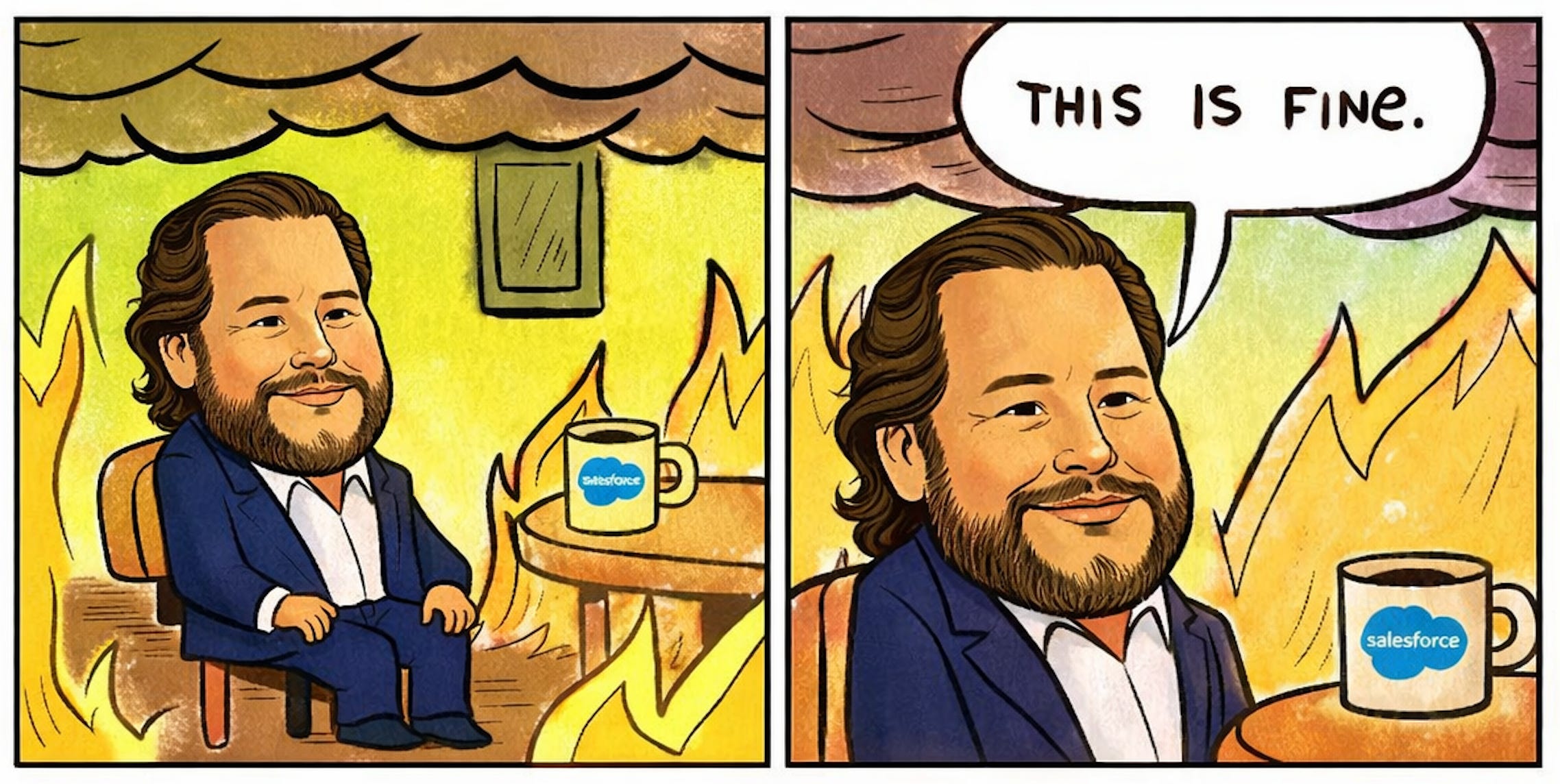
The Defiant Evangelist is the most common archetype, encompassing roughly half of public SaaS CEOs. Marc Benioff is its avatar. When Salesforce stock hit its lows (down over 20% for the year), Benioff went on his earnings call and called the death-of-SaaS narrative “nonsense” that “isn’t grounded in any customer truth.” He pointed to Agentforce as the fastest-growing product in Salesforce’s history. Meanwhile, he was laying off roughly 1,000 workers, including members of the Agentforce team itself. Jay Woods of Freedom Capital Markets called Salesforce the “poster child” for doubts about AI technology. Ball has pointed out that from 2002 to 2009, newspaper stocks declined in a straight line even as earnings grew for five of those years before the bottom fell out. When the gap between rhetoric and observable reality is that wide, bravado isn’t a strategy. It’s a tell.
The Provocateur-Disruptor is a smaller category but with an outsized blast radius. Satya Nadella provided the intellectual scaffolding for the entire selloff way back in December 2024 when he told the BG2 podcast that SaaS applications are “essentially CRUD databases with a bunch of business logic” that “will probably collapse in the agent era.” Flash forward to this February, when Alex Karp took the stage for Palantir’s Q4 earnings call and lit a match. His numbers were genuinely spectacular—70% year-over-year revenue growth, U.S. commercial revenue up 137%. But his commentary was incendiary1: “Welcome to our Palantir revolution, otherwise known as our earnings call.” “One of the truly iconic performances in the history of corporate performance or technology.” “You can divide companies into two categories: the quick and the dead.“
The market reacted directly to Karp’s argument that AI would render SaaS companies “irrelevant,” contributing to the roughly $300 billion that evaporated the following day.
And then there’s The Founder Returns, a category of one. Workday co-founder Aneel Bhusri came back from the executive chairman's seat with a $138.8 million compensation package to retake the CEO role. Something like $60 million of that requires only that he stay four years—no performance targets. The board itself isn’t sure this can be navigated. Bhusri’s return might be the most honest signal any SaaS company has sent all quarter.
A handful of companies—Cloudflare and CrowdStrike stand out here— have structurally sound arguments because AI agents directly increase demand for their products.2 Their stocks have held up better, relatively speaking. But they’re the exception, not the pattern.
What Nobody’s Saying
The most revealing thing about this entire earnings cycle is what’s conspicuously absent.
Almost no CEOs acknowledge that seat-based revenue models face structural compression, even though this is the central market concern. Nobody engages with what Ball calls “front door risk”—the possibility that AI agents capture incremental value atop existing platforms, pushing traditional SaaS down the stack to middleware. And no one acknowledges that SaaS growth rates have declined every quarter since the 2021 peak, a trend that predates AI anxiety entirely but which AI gave the market permission to reprice.
Morgan Stanley captured the environment’s verdict on ServiceNow after Bill McDermott delivered a beat-and-raise quarter that nonetheless sent the stock down 10%: “In an environment of heightened investor skepticism on incumbent application vendors, stable growth, in line with expectations, likely falls short of shifting the narrative.”
Read that line again. Stable growth likely falls short of shifting the narrative. The problem is explicitly a narrative problem, and these CEOs are losing.
One CEO Who Isn’t
Which brings me to Dylan Field.
In an exclusive interview with Alex Heath of Sources ahead of Figma’s earnings call, Field did something almost none of his peers are doing.3 He acknowledged the existential threat, engaged with it structurally, and offered a specific thesis explaining why it makes Figma more valuable rather than less.
Figma’s stock had fallen more than 80% from its post-IPO high before yesterday’s results, caught in the same sell-off punishing every SaaS company perceived to be in AI’s crosshairs. A Morgan Stanley analyst asked Field directly on the earnings call if he was “letting the fox into the henhouse” by partnering so openly with Anthropic through Claude Code integration. Where a Benioff might have called the premise nonsense and a Karp might have declared himself immortal, Field engaged.
He pointed out that virtually every frontier AI lab already uses Figma to design how they bring their models to users. He described the MCP server architecture Figma has built as infrastructure extensible to any coding tool—not a defensive moat but an open invitation. When Heath pushed him on the most extreme version of the fear—whether a sufficiently capable agent could render Figma itself redundant—Field had the line of the earnings cycle: “There's a difference between agents collecting context and agents producing work.” His argument is rooted in Jevons paradox: as AI output improves, teams will want to do more design, not less, and they'll do it in Figma.
You can agree with that thesis or not. But notice what he did that almost no other SaaS CEO is doing. He made a specific, falsifiable argument about why the structural threat operates differently in his domain. He addressed the fear of seat compression by explaining that Figma will be layering usage-based credit pricing onto its seat-based model starting in March. And he treated the Anthropic integration as an opportunity to demonstrate rather than a threat to deflect.
The stock was up more than 15% after hours.
The Comms Lesson
Most SaaS CEOs right now are still running the 2023 playbook: launch an AI product, cite early adoption metrics, declare the company a platform, and announce a buyback. But it’s 2026, and the market is discounting structural, not cyclical, risk. The ones getting punished most severely share a common trait: they treated AI disruption as a crisis to manage rather than a business-model challenge to address with specificity.
Field wove together a story. He offered a narrative explaining why the world these investors fear actually makes Figma more essential, grounded it in a specific economic concept rather than in vibe writing about the future, and took the hardest version of the question head-on rather than swatting away the easier one.
Benioff doesn’t have a thesis for his future. McDermott doesn’t have one. Karp has a thesis, but it’s about everybody else dying, which isn’t the same thing.
Field has one. And for the moment, the market is listening.
Alex Karp? Incendiary? Surely you jest.
CrowdStrike’s George Kurtz deserves some kind of award for describing AI agents as “giving full access to a drunken intern.”
The fact that Figma’s CEO gave a pre-earnings exclusive to an independent Substack publication (albeit a very high-quality one) rather than to the Journal or Bloomberg is a quiet data point about how the media landscape has shifted.