

I saw something on Twitter1 this week that made me twitch. A startup announced its pre-seed funding with a cinematic video that wouldn’t look out of place as a Super Bowl teaser from last Sunday. Moody lighting, dramatic cuts, a sweeping tagline promising to transform an entire industry. The replies filled with insider hosannahs and hyped energy. The vibes, as the kids would say, were immaculate.
My initial reaction was skepticism: why is a pre-seed company spending resources on a cinematic mood reel before shipping anything? The more I probed my thinking, though, I realized my twitch was not about the video or the announcement strategy at all, but about what comes next for startups like this.
Because I’ve seen this movie before, and the second act is where founders get into comms trouble.
The VC Twitter dopamine doom loop
What this founder did actually makes perfect sense for where they are right now. At pre-seed, your audience is investors. Your job is to sell a vision, attract talent, and set up your next raise. If you can do that with a compelling video and some well-placed signal-boosting from your lead investor, that’s smart tactics for the stage you’re in.
At seed, you’re still mostly talking to investors, but you should be starting to talk to early customers. By Series A, your primary audience needs to have shifted dramatically: to customers, partners, and industry players who will determine whether this business actually works.
The problem isn’t that founders optimize for VCs and startup Twitter early on. The problem is that too many of them never stop. Still posting for the VC reply guys and optimizing announcements for tech Twitter engagement rather than for the customers and partners who actually matter at their stage.
This is audience capture, plain and simple, and it’s one of the sneakiest traps in startup communications. Not because the founder is doing something wrong at the start (quite the opposite), but because the dopamine loop that worked at pre-seed keeps delivering hits long after the comms strategy should have changed. And nobody in the founder’s immediate orbit has any reason to tell them to stop, because everyone in that orbit — the VCs, the other founders, the tech press — is also part of the captured audience.
Sugar highs versus spinach
Performing for VC Twitter is easy to measure and fast to reward. You post an announcement, you get engagement, you screenshot the metrics, you feel like your comms are working. The feedback loop is tight and gratifying. It’s a sugar high.
Building credibility with the people who actually determine your company’s fate is slow, ambiguous, and largely invisible on social media. It’s eating your spinach. The enterprise buyer who’s going to sign your first six-figure contract is not posting fire emojis under your Series A announcement. The industry incumbent whose partnership you need is not retweeting your founder’s builder-philosopher thread. The work that moves those people (targeted outreach, credible proof points, quiet relationship-building, trade press over tech press) most likely doesn’t generate Twitter impressions. It doesn’t feel like winning in the moment.
So founders keep going back to what feels good and what the ecosystem reinforces, because VCs want portfolio companies generating buzz, accelerators teach “building in public” which often becomes “performing in public,” and tech media covers funding rounds like product launches. The whole infrastructure is optimized to keep founders talking to the wrong room.
Clubhouse was the logical endpoint of this dynamic: a company where the captured audience wasn’t just the comms strategy but the product itself. At its peak in early 2021, the app was valued at $4 billion on the strength of rooms that were, overwhelmingly, VCs and founders performing for each other. Andreessen Horowitz led the round and hosted some of its most popular rooms, a closed loop so tight it could’ve been drawn with a compass. The invite-only model was a growth hack but also a mechanism for ensuring the captured audience stayed the only audience.
When Clubhouse finally opened up, regular people wandered in, looked around, and left. The product had been so thoroughly shaped by and for the insider feedback loop that it had nothing to offer anyone outside it. Clubhouse didn’t fail to find a broader audience. It optimized itself out of one.
You only get one launch
The separate but related thing founders underestimate: you only get so many “moments” with any given audience. You get one “introducing” moment. You get one launch. You get one first-customer milestone. These are finite, and each one should be calibrated to the audience that matters most at that stage.
If you spend your “introducing” moment on a pre-seed video optimized for VC Twitter, that’s fine. VCs were your audience! But your launch moment? That needs to be built for customers. Your first partnership announcement? That needs to speak to the industry. If you’re still producing cinematic mood reels and angel-name-drop cap tables at Series A because that’s what worked before, you’ve spent your most valuable narrative capital on an audience that can’t save you.
I’ve watched this play out repeatedly over my career. The founder who built their entire communications muscle around generating VC Twitter engagement struggles to pivot when the audience shifts. They struggle to talk to enterprise buyers, don’t have relationships with trade press, and haven’t built the quiet credibility that moves conservative industries. They’ve been training for a race they’re no longer running.
Tie yourself to the mast
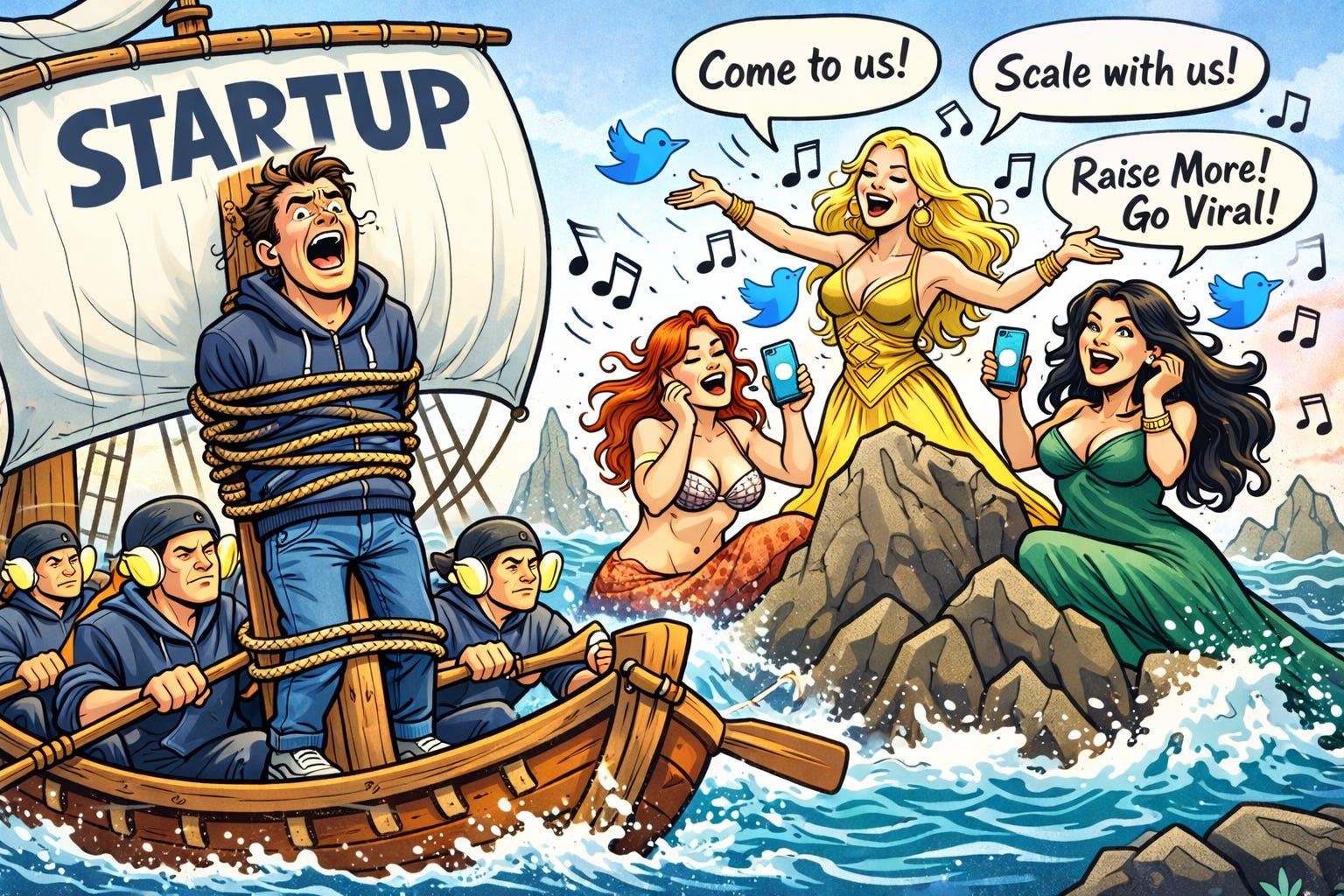
There’s a famous moment in The Odyssey2 where Odysseus knows his ship is about to pass the sirens. He doesn’t pretend their song isn’t beautiful. He actually wants to hear it. But he also knows that if he’s free to act on what he hears, he’ll steer the ship straight into the rocks. So he has his crew tie him to the mast and plug their own ears with wax. The song plays, and it’s gorgeous. But the ship sails past.
The VC Twitter engagement loop is the sirens’ song. It’s not fake. At pre-seed, it was genuinely useful. Heck, it may have been the thing that got this founder their round. The danger isn’t in hearing it, but in still steering your ship toward it when your ship needs to be headed somewhere else entirely.
If I were advising the founder whose announcement I saw, I’d tell them to enjoy it, ride the wave, and use the attention to build relationships. But six months from now, take a cue from Odysseus. Build the mast: the advisors who will tell you hard truths, the comms discipline that forces you to ask who you’re actually trying to reach, the honest self-assessment to recognize when a tactic has outlived its usefulness. Tie yourself to it. Because the song will still be playing and the ship still needs to get somewhere.
Sorry, it’s Twitter. It will always be Twitter.
Coming to a theater near you!