

I’m a 43-year-old white guy living in Marin County, so naturally, you expect me to talk about hip-hop.1
(Stick with me here.)
Let’s check in on the three protagonists of 21st-century rap’s most infamous beef. Just last night, J. Cole released “The Fall-Off,” his seventh and reportedly final album. It’s a double album, 24 tracks deep, the culmination of a project he first teased eight years ago at the end of “KOD”. He’s been building toward this moment for nearly a decade.
Kendrick Lamar won five more Grammys last Sunday, including Record of the Year for “luther,” making him the most-awarded rapper in Grammy history. The Grand National Tour with SZA grossed nearly $370 million. He’s at the absolute peak of a career built on treating every release as an event.
And Drake has been teasing his ninth album, “Iceman,” since last summer through cryptic YouTube livestream “episodes” and a drip feed of singles with no release date announced. Always present, always producing, always in the mix.
Though the three have achieved comparable levels of acclaim, they have very different relationships with attention. And these diverging approaches are more instructive frames about tech communications than you might think.
J. Cole: Directing Attention Outward
Let’s look at J. Cole first, since he just dropped. Cole spent the better part of a decade building toward a single release. He named his album after the thing every artist fears most (becoming irrelevant), then layered narrative across multiple projects, dropped hints in lyrics and interviews, and let anticipation compound until the release carried the weight of his entire career arc. “The Fall-Off” is the final chapter of a story that started with a mixtape called “The Come Up.”
But the defining Cole move is actually his label, Dreamville. He treats it as an ecosystem where he platforms other artists, produces for them, and creates events like Dreamville Fest, positioning him as a curator and community builder, not just a performer. He directs attention outward while quietly consolidating his own influence. He’s your favorite rapper’s favorite rapper, respected most deeply by the people actually doing the work.
The tech attention parallel is Stripe. Patrick and John Collison built a company that deliberately focuses on its customers' success rather than its own. The whole narrative is: we’re the infrastructure that makes ambitious companies possible. Stripe Press publishes books about economic progress and ideas that have nothing to do with payments, the same way Cole invests in documentaries, festivals, and artist development that transcend his own catalog. Both are saying the same thing: our taste and judgment matter as much as our core output.
Cole doesn't chase moments. He shows up steadily, delivers quality, and stays accessible without being overexposed. Stripe maintains the same rhythm: they publish, they speak at events, they ship, but they never feel like they're performing for attention. The consistency is the strategy.
The risk of this approach is specific to its generosity. When you spend years directing the spotlight toward your ecosystem, your customers, your community, you may train the market to look past you. Cole can sell out arenas, but the cultural conversation consistently treats him as the third name in the Cole-Kendrick-Drake trinity, despite arguably the most consistent catalog of the three. Stripe processes hundreds of billions in payments, but when the press covers a Stripe-powered company’s IPO, the story is about the company, not the infrastructure that made it possible. You become the stage, not the performer.
The tell that you’re executing this well versus poorly: are the practitioners in your space citing you as the standard? Or have you directed so much attention outward that even your advocates forget to mention you?
Kendrick Lamar: Strategic Scarcity
Kendrick operates in cycles of intense visibility followed by deliberate silence, and every cycle raises the stakes. Five years between “DAMN.” and “Mr. Morale & The Big Steppers” would kill most rappers’ momentum. For Kendrick, it built anticipation because the previous work justified the wait. “GNX” arrived as a surprise drop with zero advance singles. No rollout, no press tour. Just the work, landing like a meteor. The silence is the marketing.
The tech company that runs this play most clearly is Rockstar Games.2 They go completely dark for years between releases: no executive interviews, no conference appearances, no social media engagement from leadership, minimal corporate communication. Then they drop a single trailer, and it becomes the biggest cultural event in entertainment. GTA VI’s first trailer broke YouTube records without Rockstar doing a single press briefing. The work speaks, full stop.
But strategic scarcity only works if you have something worth the wait. Applied to mediocre work, it just creates an embarrassing gap between buildup and reveal. “GNX” could arrive unannounced because “DAMN.” and “To Pimp a Butterfly” and “good kid, m.A.A.d city” preceded it. GTA VI can coast on years of silence because GTA V sold 200 million copies. The catalog is the credibility.
Some honest indicators of whether a company has earned this posture: Is organic community growth happening without paid acquisition? Are strong candidates reaching out unprompted? Are journalists requesting access, or does every piece of coverage require extensive outreach? If the answers are mostly no, you haven’t earned strategic silence. You’re just… silent.
Kendrick didn’t start here, either. He had years of “Section.80” and “Overly Dedicated” and regional buzz, building a foundation. The discipline was in knowing when he’d earned the right to go quiet.
Drake: Omnipresence and Absorption
Drake’s attention strategy isn’t subtle and doesn’t pretend to be. He simply never cedes the conversation. A feature here, a loosie there, an Instagram caption that becomes a meme, a beef that dominates a news cycle, a surprise drop that resets the discourse. He treats every platform as a distribution channel and every moment as an opportunity to be in your feed. The “Iceman” rollout underway is classic Drake: drip-feeding content across platforms, staying perpetually in the cultural conversation, treating presence as its own form of leverage.
You can have a favorable or unfavorable opinion3 about Drake, but you can’t forget he exists.
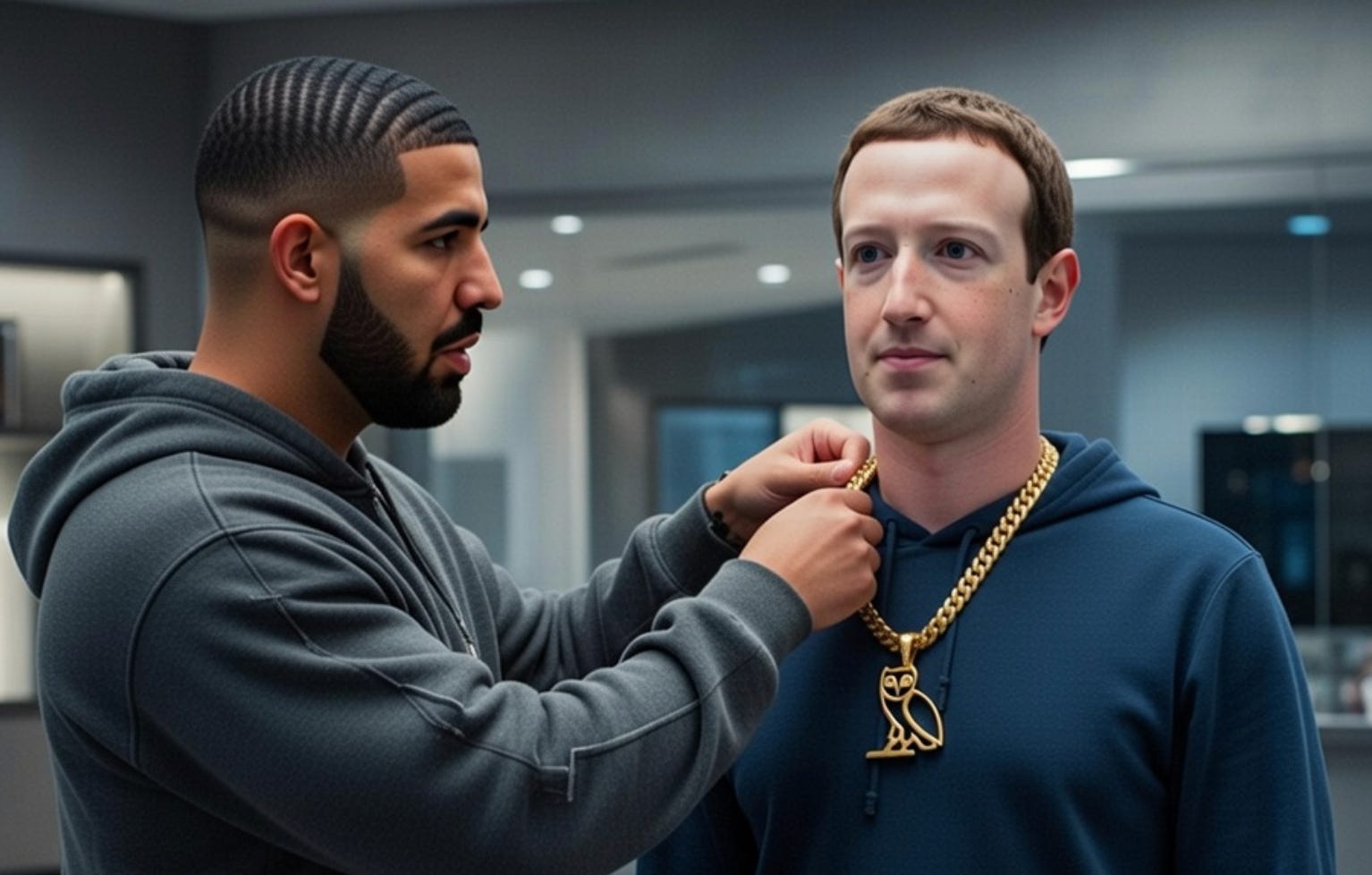
The tech parallel is Meta. Zuckerberg’s company operates at the same relentless cadence—always shipping, always announcing, never letting a competitor’s moment go unanswered. TikTok surges? Reels ships within months. Twitter stumbles? Threads launches overnight. OpenAI captures the AI narrative? Meta pivots to open-source AI and floods the zone. Stay in the conversation at all costs, and trust that the distribution advantage will sort out the rest.
There’s a persona dimension, too. Both Drake and Zuck constantly read the room and shape-shift to stay relevant, which prompts a persistent question about authenticity that neither seems particularly troubled by. The reinventions aren’t distractions from the strategy. They’re part of it, each metamorphosis another reason to pay attention.
This is still the default mode in tech comms, and there are real contexts where it’s the right call.4 Pre-product-market-fit, you need awareness. Silence isn’t strategic, it’s suicidal. In enterprise, where buyers need constant reassurance that a vendor is active, going quiet creates procurement anxiety. Cadences exist for a reason.
The problem is when omnipresence becomes the only play, which is where most startups end up. Every product update gets a blog post, every integration gets a press pitch. This playbook made more sense when the tech press was a bigger ecosystem that would reliably cover your Series B or your Salesforce integration. Now it has diminishing returns. Journalists are burned out on undifferentiated pitches, the trade press has contracted, and your startup is in the same infinite scroll as everyone else’s.
Drake’s omnipresence works because he’s an artist with an audience so massive that even a mid single charts. Meta’s success stems from its having two billion users and its ability to ship to all of them overnight. Most companies don’t have that luxury. Presence without substance trains the market to expect noise rather than signal. Each announcement that doesn’t land makes the next one easier to ignore.
Matching the Strategy to the Moment
Here’s the thing most people reading this need to hear: you’re probably not Cole, Kendrick, or Drake yet, and that’s fine. You’re probably in your mixtape phase. The goal isn’t to run any of the three strategies above. It’s to build a catalog good enough to earn the right to choose one.
For a company in the mixtape phase, the job is straightforward if unglamorous: ship good work, figure out what resonates, build relationships with the journalists and communities that matter, and develop an instinct for what’s worth talking about. Some version of the Drake play, calibrated to your resources, usually makes sense here. But it should be in service of building the foundation, not mistaken for the strategy itself.
The honest question to ask: have we built enough of a catalog that any of these strategies is available to us? Or are we still proving we belong?
The hardest part of all this is that you’re rarely running one strategy across the board. Your developer audience might respond to Kendrick’s scarcity. Your enterprise buyers need Drake’s reassuring presence. Your platform and ecosystem story might warrant the Cole treatment.
Cole earned his ecosystem. Kendrick earned his silence. Drake earned his volume. The question isn’t which of these strategies is best. It’s whether you’ve earned the one you’re running.
Though 2Pac did attend high school here.
It’s tempting to say Apple here because of the way they release products, but they keep up a constant brand presence and marketing between those releases in a way Kendrick never would.
And oh boy, do we.
Though I’m not sure most startup founders would take it as a compliment if someone told them, “You’re just like Drake!”